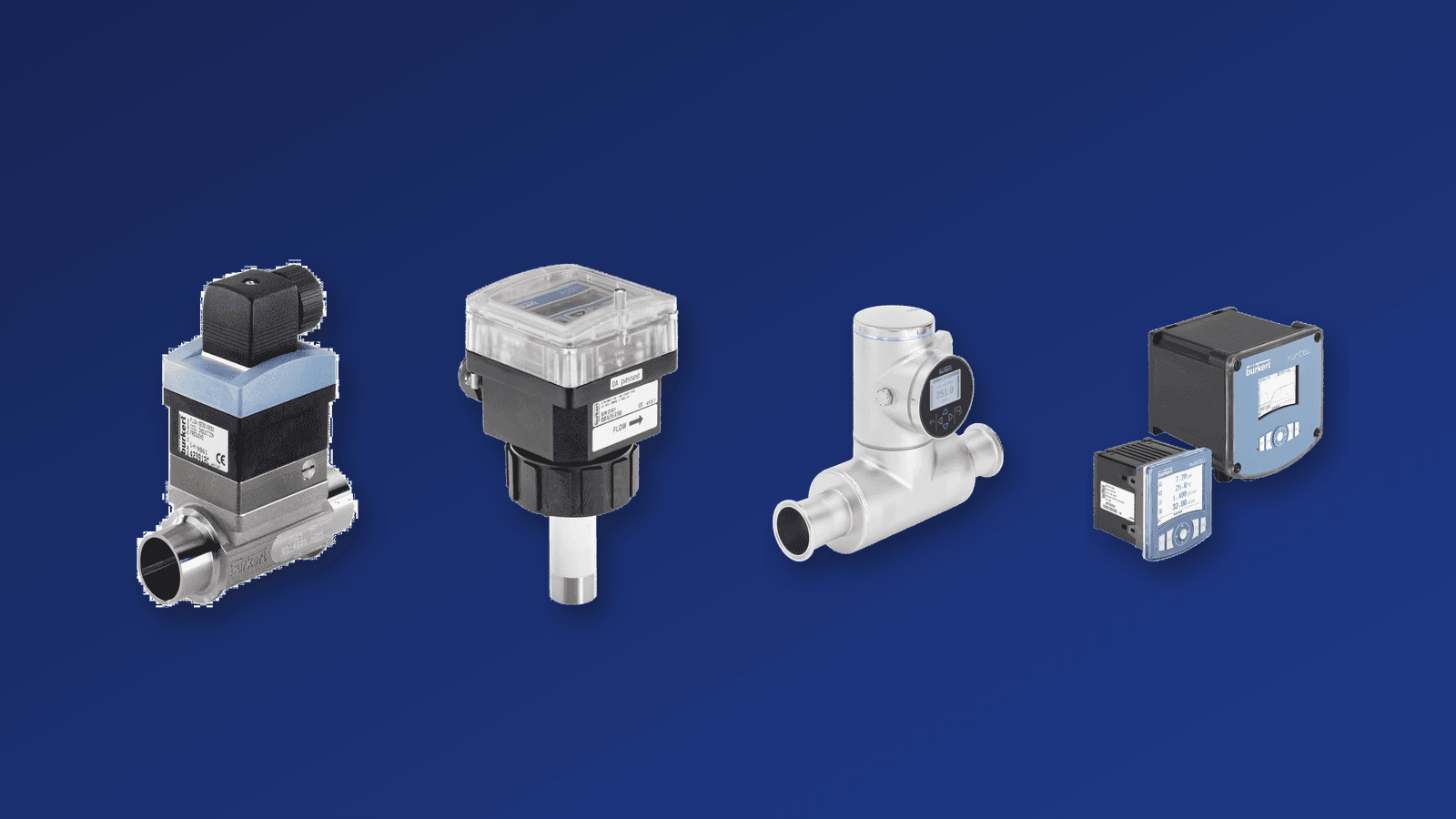
Choosing a flow sensor for water treatment, utilities or a hygienic process usually comes down to three technologies: a paddle wheel, an electromagnetic (mag) meter, or a newer surface acoustic wave (SAW) meter. Each has a sweet spot defined by the liquid, its conductivity and cleanliness, and the hygiene the line demands.
This guide compares Bürkert's Type 8030 paddle wheel flowmeter, Type 8045 electromagnetic insertion flowmeter and Type 8098 FLOWave SAW flowmeter using Bürkert's published data.
Paddle wheel: economical for clean liquids
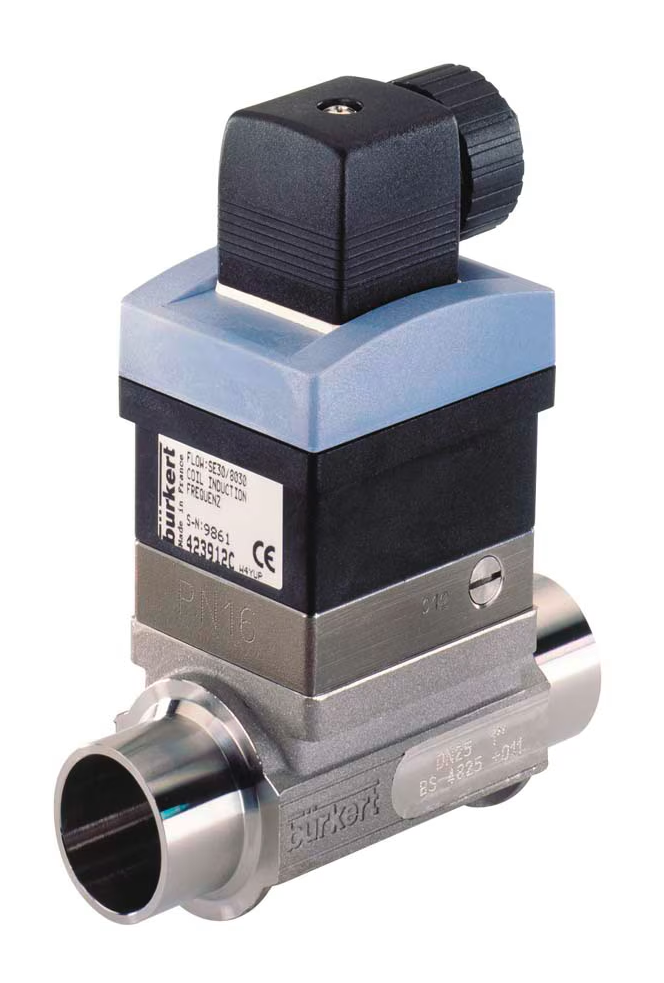
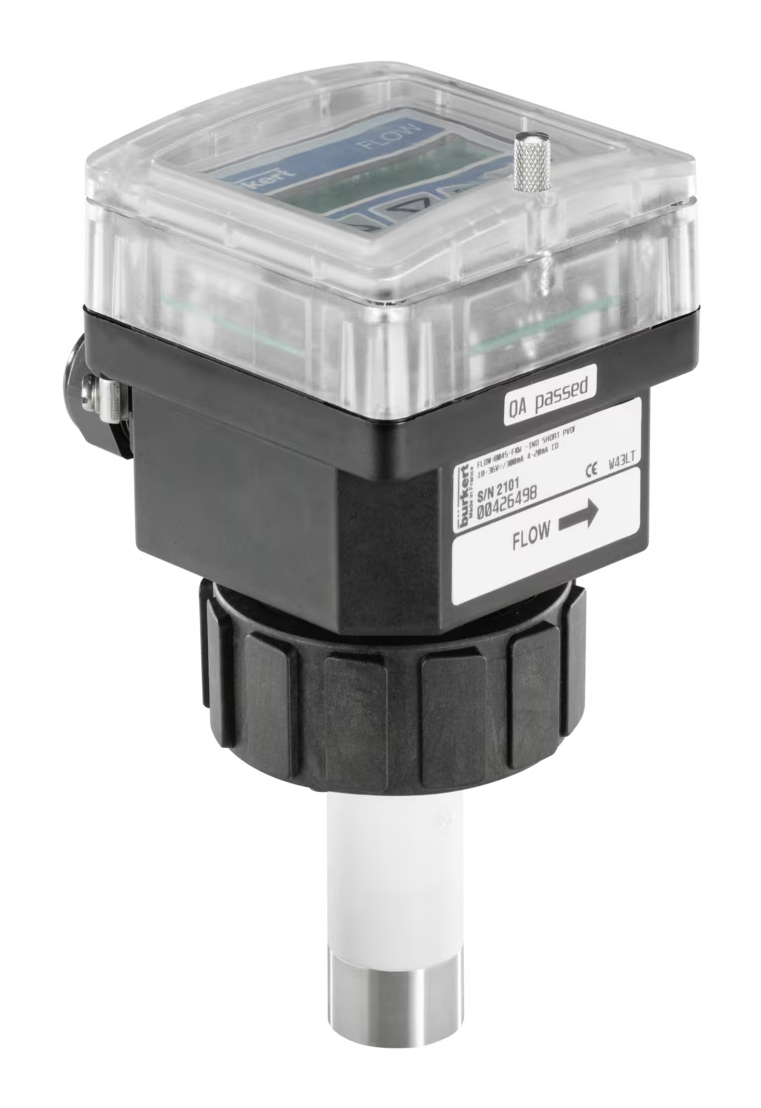
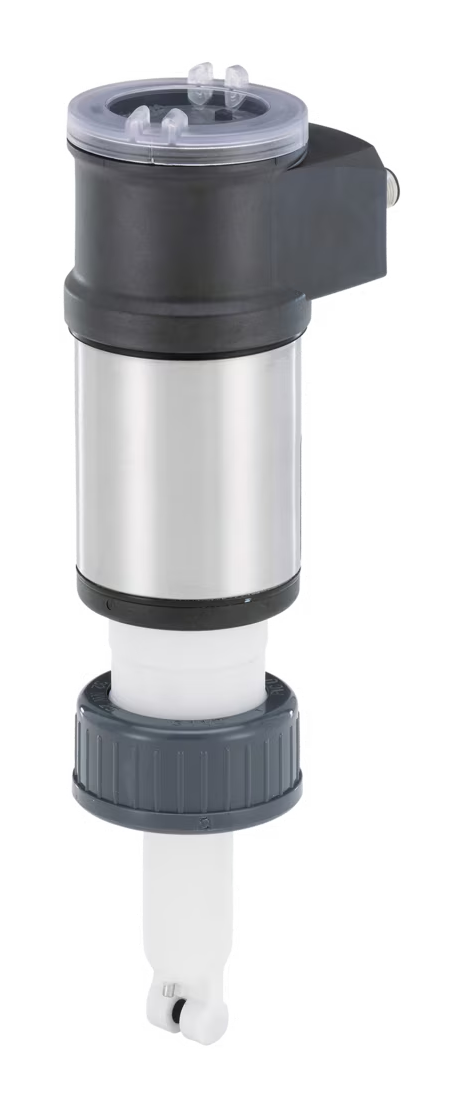
A paddle wheel sensor counts the rotation of a small rotor in the flow. It is simple and economical, but it has a moving part, so it is meant for clean liquids. Bürkert positions the Type 8030 for neutral or mildly aggressive, particle-free liquids. It combines an inline sensor fitting with a transmitter on a quick bayonet mount, outputs a pulse frequency proportional to flow, and offers a 3-wire PNP/NPN variant for direct PLC connection. The 8030-HT variant is rated to 125 °C and 40 bar.
Electromagnetic: no moving parts for conductive liquids
A magnetic flowmeter measures the voltage induced as a conductive liquid moves through a magnetic field. With no moving parts, it tolerates dirtier water better than a paddle wheel, but the liquid must be conductive. The Type 8045 is an insertion design for pipes from DN 06 to DN 400 and liquids above 20 µS/cm. Bürkert lists a backlit display showing flow rate and volume, simulation of all outputs, CIP-compatible FDA-compliant materials and an alloy C22 electrode option for aggressive chemicals and seawater.
SAW: hygienic, and works on low-conductivity water
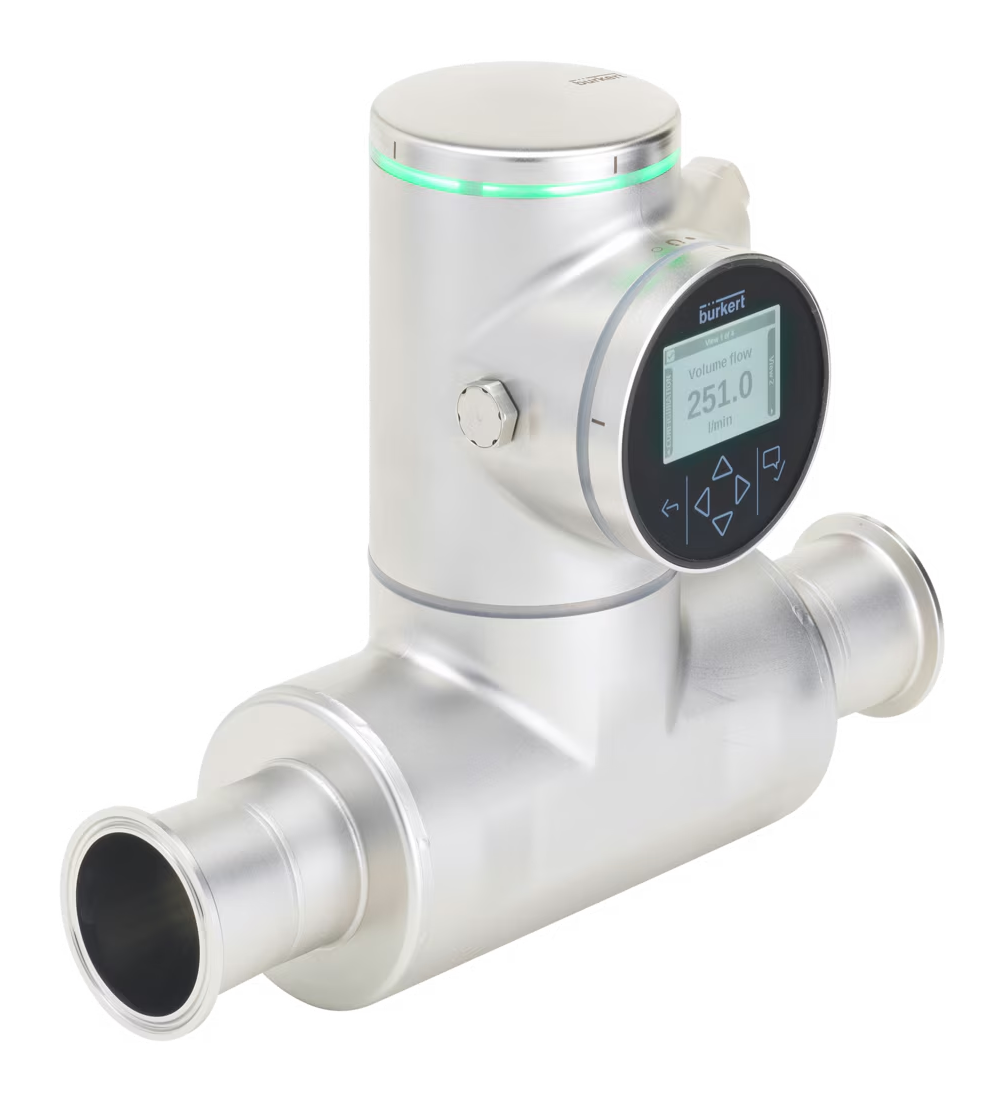
Surface acoustic wave technology measures flow with acoustic waves through the tube wall, so the measuring tube is completely free of internal parts. The Type 8098 FLOWave is designed for the highest hygienic demands, is CIP/SIP compatible and, unlike a mag meter, is suitable for liquids with low or no conductivity, such as water for injection (WFI). Bürkert lists büS/CANopen, Modbus TCP, PROFINET, EtherNet/IP, EtherCAT and IO-Link options, plus optional ATEX/IECEx and HazLoc approvals.
| Paddle wheel (8030) | Electromagnetic (8045) | SAW (8098 FLOWave) | |
|---|---|---|---|
| Moving parts | Yes | No | No; tube free of internal parts |
| Liquid requirement | Clean, particle-free | Conductive, above 20 µS/cm | Low or no conductivity OK |
| Pipe range noted | Inline fittings; HT variant to 125 °C / 40 bar | DN 06 to DN 400 (insertion) | Hygienic inline |
| Hygiene | General industrial | CIP compatible, FDA materials | CIP/SIP, highest hygienic demands |
| Typical use | Cooling, dosing, machine water | Water, wastewater, chemicals, seawater | Pharma purified water, WFI, food |
Bringing flow and water quality together
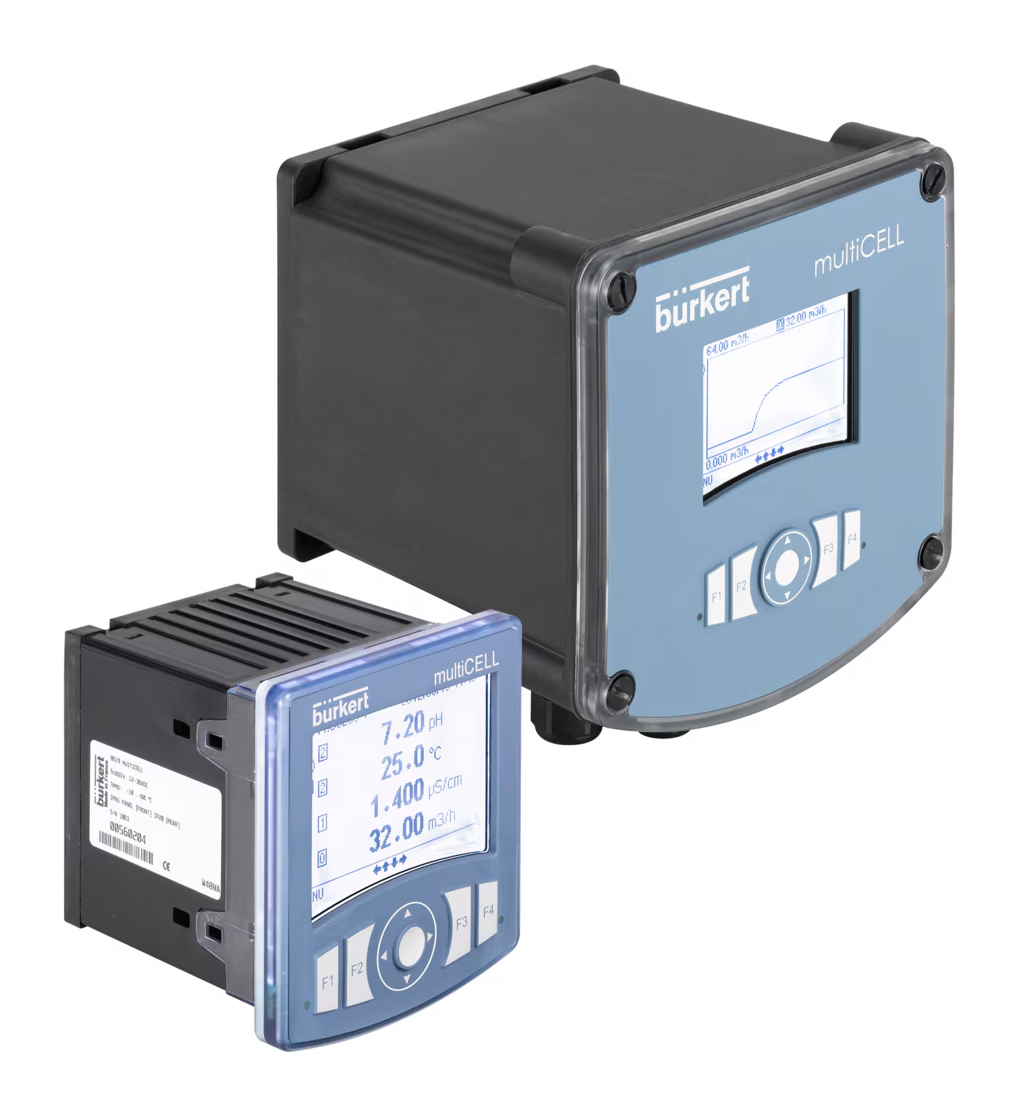
On water treatment and dosing skids, flow is rarely measured on its own. The Bürkert Type 8619 multiCELL is a multi-channel transmitter/controller that accepts flow, pH, ORP, conductivity and chlorine inputs, with a large backlit display, up to six free slots and an Industrial Ethernet option. Pair it with the Type 8222 conductivity meter and Type 8202 pH/ORP transmitter, or step up to the Type 8905 online water analysis system for drinking and process water.
Selection checklist
- Is the liquid clean? If yes and budget matters, start with the paddle wheel 8030.
- Is it conductive, possibly with some particles? Choose the electromagnetic 8045.
- Is it low-conductivity or hygienic (purified water, WFI, food)? Choose the FLOWave 8098.
- Check temperature, pressure and pipe size against the data sheet.
- Decide whether you need a controller such as the 8619 for dosing or multi-parameter monitoring.
Territory Instruments can quote Bürkert flow sensors and analysis transmitters for your pipe size and liquid.
Frequently asked questions
Can a magnetic flowmeter measure demineralised or WFI water?
Magnetic flowmeters need a conductive liquid; Bürkert specifies the 8045 for liquids above 20 µS/cm. For low- or zero-conductivity water such as WFI, Bürkert positions the FLOWave 8098 SAW flowmeter.
Is a paddle wheel flowmeter suitable for dirty water?
Bürkert specifies the paddle wheel 8030 for neutral or mildly aggressive, particle-free liquids. For water with particles, an electromagnetic meter such as the 8045 is usually the better choice.
What is a SAW flowmeter?
A surface acoustic wave flowmeter uses acoustic waves through the tube wall to measure flow, so the measuring tube has no internal parts. Bürkert's FLOWave 8098 is a SAW flowmeter designed for hygienic applications.
Can one controller handle flow, pH and conductivity?
Yes. The Bürkert Type 8619 multiCELL accepts flow, pH, ORP, conductivity and chlorine sensor inputs in one panel or wall-mounted unit.